

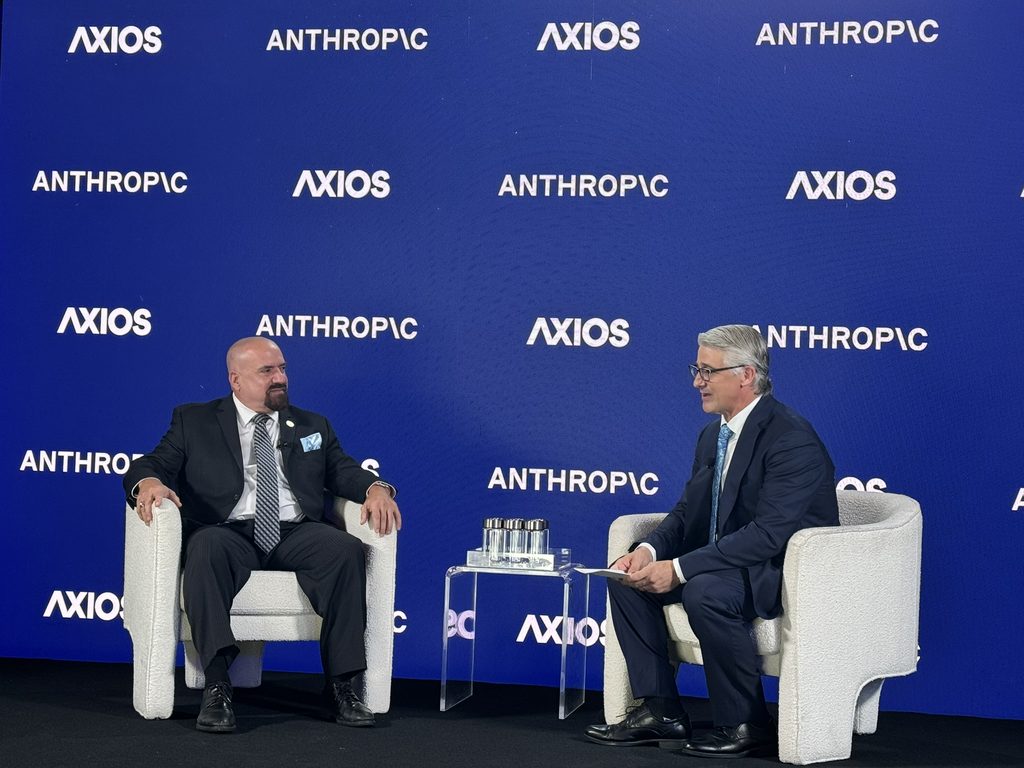
Florida AI regulation is sitting in a strange holding pattern right now, and you could feel it in the room this morning. Axios Live brought its AI Across America series to the Coral Gables Woman’s Club, a short walk from my side of the Gables, and Miami Mike got there early enough to get coffee before the doors filled. Ninety minutes, no panels of eight people talking over each other, just four one on one conversations on a small stage.
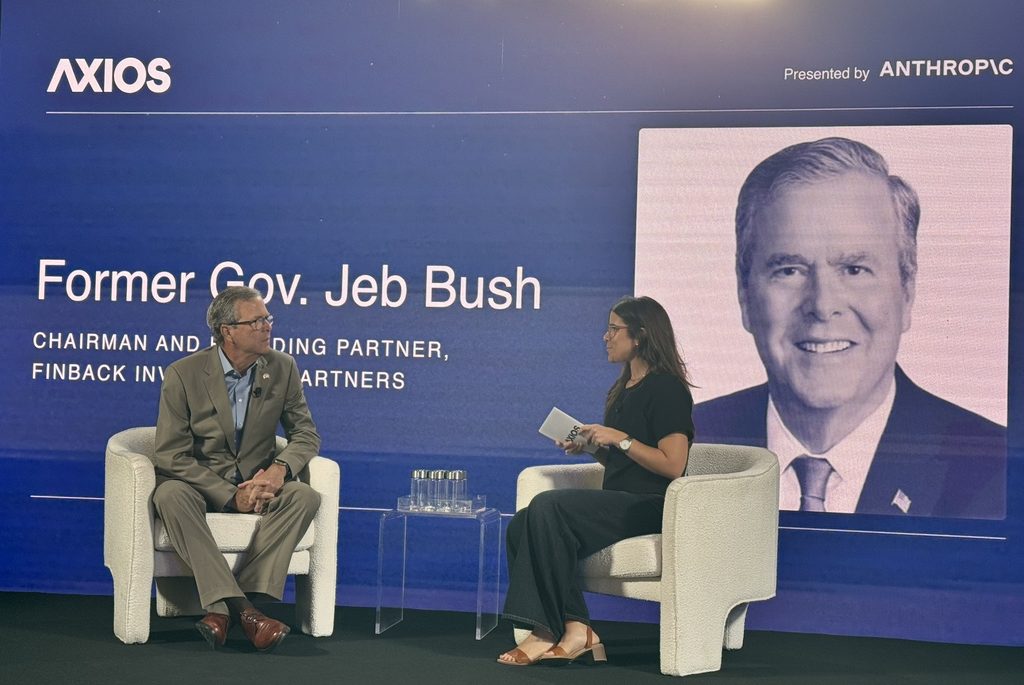
Short version for anyone who missed it. Axios reporters interviewed a former Florida governor, a national school choice figure, a sitting Miami city commissioner and Anthropic’s head of state and local government relations. The event was presented by Anthropic and ran from 8:00 to 9:30 on September 2. Four people got asked some version of the same question about Florida AI regulation and gave four different answers, which is the most honest picture of where this state actually is.
Who spoke at the Axios Miami AI event
Axios Miami reporter Sommer Brugal and senior political reporter Marc Caputo handled the interviews, with publisher Nicholas Johnston moderating the View From the Top segment. The full lineup is still up on the event registration page.
| Speaker | Role | What they came to argue |
|---|---|---|
| Jeb Bush | Chairman and Founding Partner, Finback Investment Partners | Florida should structure the AI buildout rather than ban it, and should fix permitting with it |
| Cesar Fernandez | Head of U.S. State and Local Government Relations, Anthropic | Put the safety burden on the handful of companies building the models, not on 3 million small businesses |
| Damian Pardo | Commissioner, City of Miami District 2 | Growth only counts if residents get something for it, and DeSantis is right to regulate |
| Erika Donalds | Founder, Education Freedom Foundation | Protect kids from harm, not from their parents’ choices, and use rule making instead of statute |
Two of the four are education people. That tells you where the political heat in Florida actually sits right now. It is not enterprise adoption. It is kids and chatbots.
What happened to the Florida AI Bill of Rights
Nobody on stage named the bill. Everybody in the room was talking about it.
Governor DeSantis spent the winter pushing SB 482, the Artificial Intelligence Bill of Rights. Thirty three pages. Parental consent before a minor could hold an account on a companion chatbot platform. A requirement that bots periodically remind you that you are not talking to a person. A right to know when a political ad was made with AI. A ban on state agencies contracting with AI firms tied to a foreign country of concern. Companies got a 45 day window to fix violations before penalties landed.
The Senate passed it 35 to 2 on March 4. Then it died. The Florida Senate’s own bill page records the last action as March 13, 2026, died in Messages. House Speaker Daniel Perez never brought it to the floor. Trump had signed an executive order in December aimed at keeping states out of AI rulemaking, and Perez took the position that a technology question touching national security belongs to Washington. DeSantis disputed that a presidential order can preempt state law. Neither side moved, and the session ran out.
So Florida enters the back half of 2026 with no comprehensive AI statute. FSU Law’s review of the session describes the state’s approach as a set of discrete pieces rather than a framework: synthetic media, election disclosure, consumer protection, government operations, data infrastructure. Nothing that tells a Florida company what it must do before it deploys a model.
Four answers to the same question about state AI regulation
State versus federal AI regulation is the fight that decides your compliance picture in two years. What made the morning interesting is that four people who broadly agree on Florida’s direction gave four incompatible answers about it.
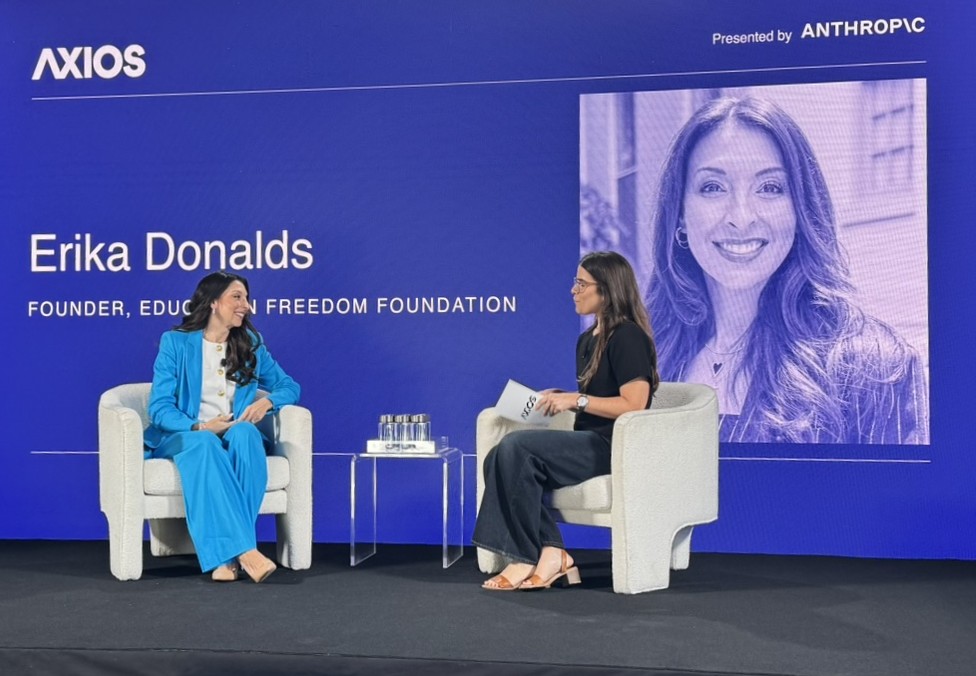
Donalds gave the sharpest one, and she got there without mentioning the bill. Her line is that the state has a responsibility to protect children from harm, and not to protect children from parental decisions and preferences. She thinks the internet safety and student privacy laws already on the books can be clarified to cover AI rather than replaced with something new. Then she made the argument I have not heard anywhere else: prefer rule making over legislation. The legislature meets 60 days a year and good bills die on the floor for reasons that have nothing to do with their merits. The State Board of Education and your local school board meet monthly and can tighten or loosen a rule as the technology moves. Her warning was that legislatures write law against the worst case they read about, and in doing so block a lot of things that work.
Pardo went the other way and said so plainly. Asked whether the governor’s push to regulate AI was a mistake, he said it was a good idea. His reasoning was local rather than ideological. Residents in his district are raising electricity rates, water quality and data centers with him directly, and he represents those residents. He also said the human supervisory element of AI is something a lot of people want kept in place.
Fernandez made the industry case for state involvement, which is not the same as the industry case against it. His framing was a choice between two ways to harden Florida against AI enabled cyber attacks. You can ask millions of small businesses and hundreds of government agencies to move fast and defend themselves. Or you can make sure the largest companies building the most powerful systems build the safeguards into the technology. He said there is a role for state government in making the second one the industry standard, and cited polling that 73 percent of Floridians think government should have a role at all. His stakes were Florida’s seaports, which support about 1.2 million jobs and, by the state’s own 2023 analysis, roughly 12 percent of Florida GDP. He said 13 on stage.
Coming from a frontier lab’s government relations lead, at an event that lab paid for, that is a more interesting position than the room seemed to register.
The permitting problem two speakers agreed on
This was the best local moment of the morning and it happened by accident.
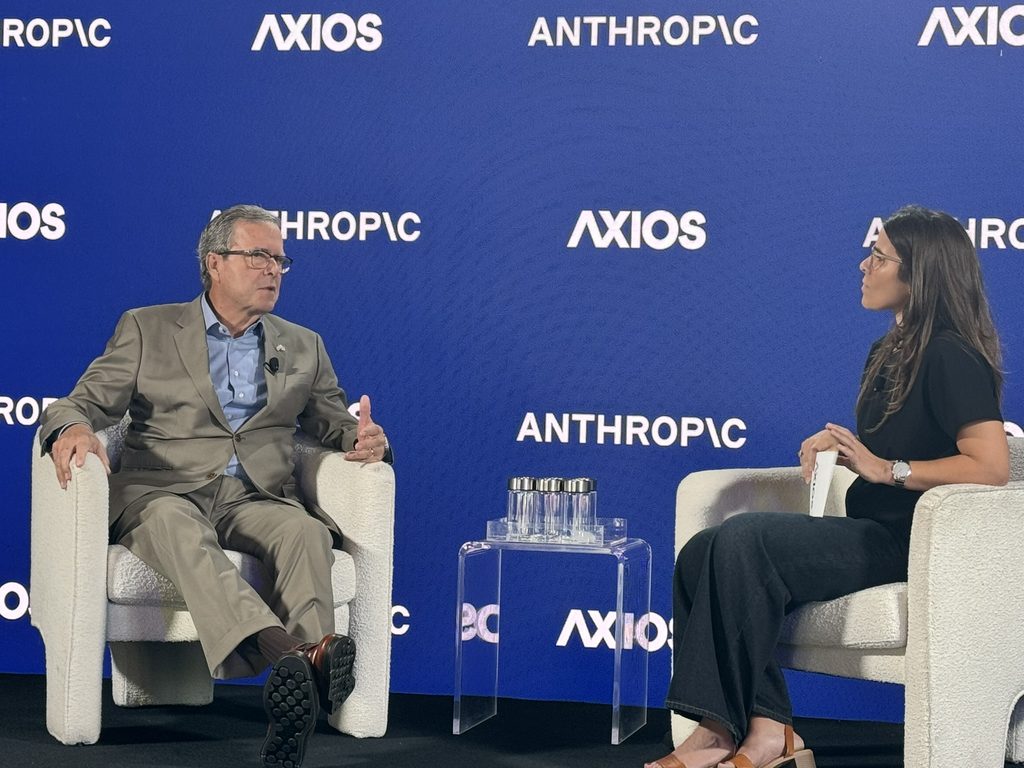
Bush, talking about where AI should be pointed in Florida, said getting a permit in Coral Gables requires a genuinely patient person. He lives here. He said it anyway, about a mile from City Hall. His point was that a comparable job in Texas gets done in half the time, that South Florida has a cost of living problem serious enough that population is now declining rather than growing, and that accelerating permitting without gutting environmental review is a better use of AI than most of what gets discussed.
An hour later Pardo opened by referencing that exact comment and saying Miami is worse. Then he described what the city is already running:
- Permitting systems being rebuilt so applications move faster through review
- A code compliance chatbot residents can question directly and get an answer from immediately
- Planning and zoning verification letters, funded by a Google grant of roughly $250,000, which he said turned a painful request into an easy one and is the piece residents actually like
- Forward facing tools so residents can ask the city questions instead of filing for answers
- An ambition he floated rather than announced: querying city contracts after the fact to surface which ones came in well above their contracted value
That last one is worth watching. Miami has a reputation on procurement, Pardo acknowledged it directly, and pointing a model at your own spending is a very different act of political courage than putting a chatbot on a code compliance page.
If you sell to municipalities in South Florida, this is your roadmap. Permitting, code compliance, zoning verification, procurement analysis. In that order.
AI in Florida schools and who gets to decide
Donalds is a genuine convert, and she said so first thing, which bought her credibility for everything after.
She spent almost twenty years as an investment manager, then ran for the Collier County school board, then founded a network of classical schools with no technology in the classroom at all. That was a deliberate reaction to a wave of ed tech that parents did not think worked. COVID forced her to build an online program, parents refused to give it up, and that became Optima Academy Online, now serving more than 2,000 students.
She sits on Florida’s education AI task force representing districts and charters, and her read is that nobody in the state is being loose with chatbots in classrooms. What she sees is narrow, careful deployment of tools that already taught a specific skill well and then had an AI layer added. Two examples she gave, both concrete enough to be useful:
In her virtual reality school they build avatars of historical figures, Thomas Jefferson and Rosa Parks among them, backed by small models trained only on that person’s own writings and on trusted accounts of them. A student interviews the figure and the model cannot wander outside the trusted set. That is retrieval discipline applied to a classroom, and it is a better answer to hallucination than most enterprise deployments I see.
The second is an adaptive reading tool running in a Florida district that holds 250 different ways to teach a phonetic sound and learns which one works for which child. Narrow purpose, no open ended chat, no companion dynamic. Her argument is that this is what is actually proliferating in Florida schools, and that the thing legislators are worried about mostly is not.
On teachers she was blunt. There are schools removing teachers and putting AI in their place, and she does not meet parents who want that. Her position is that AI should expand what a teacher can do and never touch the part only a teacher does, which is the human connection and the ability to make a kid care about a subject. She paired it with a harder truth about the teacher shortage: for a lot of American students the realistic comparison is not AI against a great teacher, it is AI against no qualified teacher in the room.
None of the SB 482 education provisions became law. Districts are writing their own rules in the meantime, which is exactly the patchwork the legislature was trying to prevent and, by Donalds’ logic, is also the level where the rules should probably live anyway.
Is Miami actually an AI hub or just a good backdrop
I sell AI infrastructure into companies across this region, so I want the Miami story to be true. This morning produced the first numbers I have seen that make it hard to dismiss.
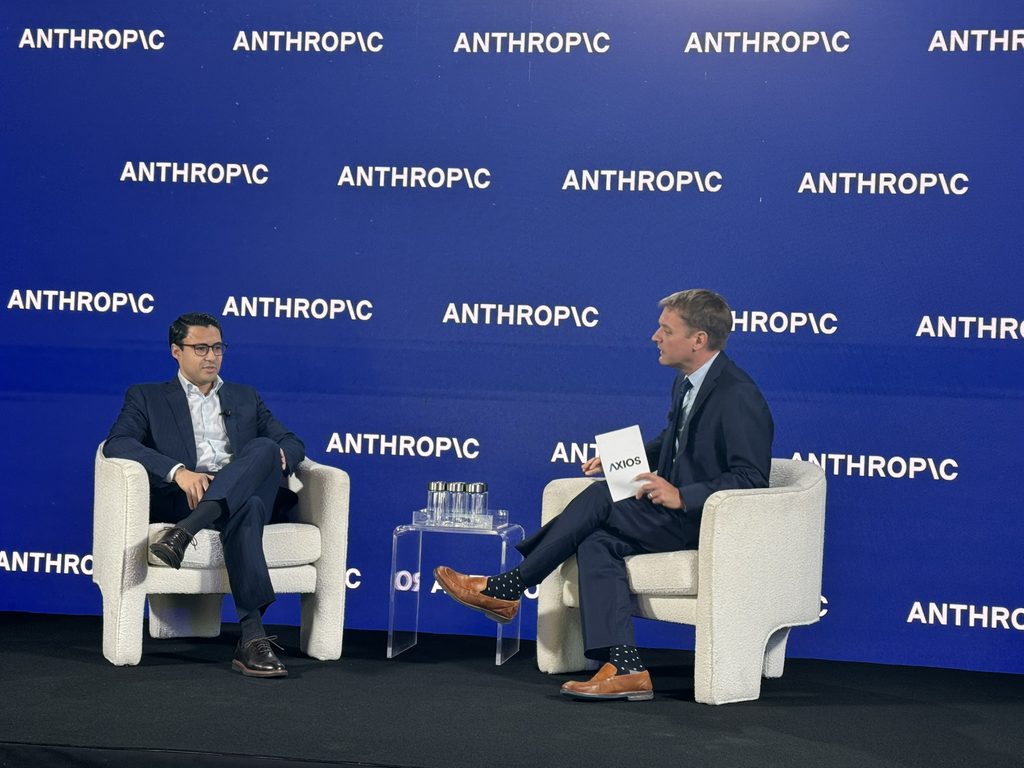
Fernandez, who is Miami born and ran Uber’s Florida government affairs before Anthropic, said the company published Florida specific data from its Economic Index the morning of the event. His figures: more than 3 million Floridians hold a Claude account, sending over 120 million messages a month, with the state ranking sixth in the country for workplace AI adoption. He put the time saved at roughly 47 million hours a month and made the point that matters, which is that a small business owner who gets those hours back reinvests them rather than going to the beach.
His example was a two person solar company in Doral running its back office on Claude so both people can stay on roofs instead of paperwork. He said they were in the room. Miami Dade College also came up, putting the tools in front of teachers and students and building courses around them.
Pardo brought the other half of the ledger. Around 2,000 startups supporting roughly 90,000 jobs, and a startup ecosystem he valued near $96 billion. The Beacon Council puts that last figure at about $95 billion, and it is an ecosystem valuation rather than the size of a tech economy, which is a distinction worth keeping straight. Venture capital into the region went from roughly $90 million in 2010 to about $1.2 billion by 2020, and his figures stopped there. The current numbers are larger still, with South Florida startups raising $4.13 billion in 2025. Citadel is moving its global headquarters to a Foster and Partners supertall on Brickell Bay Drive, roughly 1.3 million square feet of office space in a building reported at around $2.5 billion, with groundbreaking now expected later this year. He cited an Economist piece published that same day putting Miami Dade metro economic growth at 23 percent between 2020 and 2024.
Then he said the honest thing. He does not think Miami becomes Silicon Valley and does not think it should try. His pitch is that Miami is where companies put the headquarters that runs Latin America and the Caribbean, and that the real asset is capital sitting next to technology and finance in the same square mile.
He also named the constraint, which nobody selling Miami usually does. There are not enough engineers here. The regional universities are training people and it is not keeping up, and the urban core densified so fast that the schools and infrastructure a technical workforce needs did not come with it. Asked for the solution he said he does not think there is one, just everybody doing as much as they can. That answer is worth more than an optimistic one.
The data center question Florida keeps sidestepping
Bush was the only person who took this on directly, and his answer was not the one either side wants.
He does not think Florida becomes a center of hyperscale buildout, because the state does not have the energy sources Texas has. He also thinks refusing to engage is the wrong response. If hyperscale does come, he wants it structured: sited in rural counties that got left behind economically, Glades County by name, with guaranteed lower property taxes for residents, six figure jobs people are trained into, and recycled water rather than drawn down water. Structure it or lose the benefit, but do not ban it.
The one piece of DeSantis’ AI agenda that did become law points the same direction. SB 484, signed in May, keeps utility ratepayers from absorbing costs that large data centers push onto the grid. The consumer protection half of the agenda failed twice, in regular session and in a special session. The half about your power bill passed and got a signing ceremony. Electricity prices are a kitchen table issue in Florida and chatbot guardrails are not, at least not yet.
What Florida AI regulation means for your business right now
You are operating in a gap, and gaps close. Here is how I would spend the next few months running a company in Miami-Dade or Broward.
- Write down every place a model touches a customer. Not a policy document, a list. When disclosure rules land, and some version of them will, the companies that already know where their bots talk to people will spend a week complying instead of a quarter.
- If you sell to a Florida city, county or district, read the dead bill anyway. Its government contracting language is the clearest available signal about what procurement asks you for next. And take Pardo’s list seriously, because that is a sitting commissioner telling you his roadmap in public.
- Watch the rule making, not just the statute. Donalds is right that the State Board of Education and local boards move monthly while the legislature moves once a year. The rules that hit you first will probably not arrive as a bill.
- Do not architect around one vendor’s compliance posture. Rules that hit a companion chatbot platform look nothing like rules that hit an enterprise API, and you want the freedom to move. That is the whole case for a multi model AI strategy rather than a provider you cannot leave.
- Get honest about what the workload costs before you scale it. Regulatory risk gets the headlines, but I watch more projects die on AI inference costs than on anything a legislature has ever done.
- For anything genuinely sensitive, hardware you control is the answer that survives every version of these rules. Data that never leaves the building is nobody’s disclosure problem. I have written up when on premise AI inference actually pencils out, and the deciding variable is utilization, not the legal picture.
- Test on something small before you sign anything. I run a DGX Spark home lab for exactly that, and it has killed more of my own bad ideas than any vendor deck ever has.
One thing I would not do is wait for clarity. Florida gets a 60 day session once a year and Congress has been introducing AI bills without passing one for three years running. Anyone building a roadmap around a rule arriving is building a roadmap around a coin flip.
The full session is on the Axios Live YouTube channel if you want to hear any of this in the speakers’ own words. It runs about ninety minutes.
What I am watching between now and January: whether a federal framework actually shows up, whether Tallahassee refiles SB 482 with the education provisions intact or strips them to get it past the House, and whether Miami’s permitting tools ship or quietly stall the way city technology projects usually do. Those three decide more about how Florida AI regulation lands on your business than any product launch will.




[…] SB 482, the Artificial Intelligence Bill of Rights, passed the Florida Senate 35 to 2 on March 4, 2026. It would have restricted how governmental entities contract for AI products, and it carried an effective date of July 1, 2026. Then it died in House Messages on March 13. No chapter law citation. It is not on the books. I went through the politics behind that collapse, and what four speakers made of it on stage in Coral Gables, in my writeup on Florida AI regulation. […]