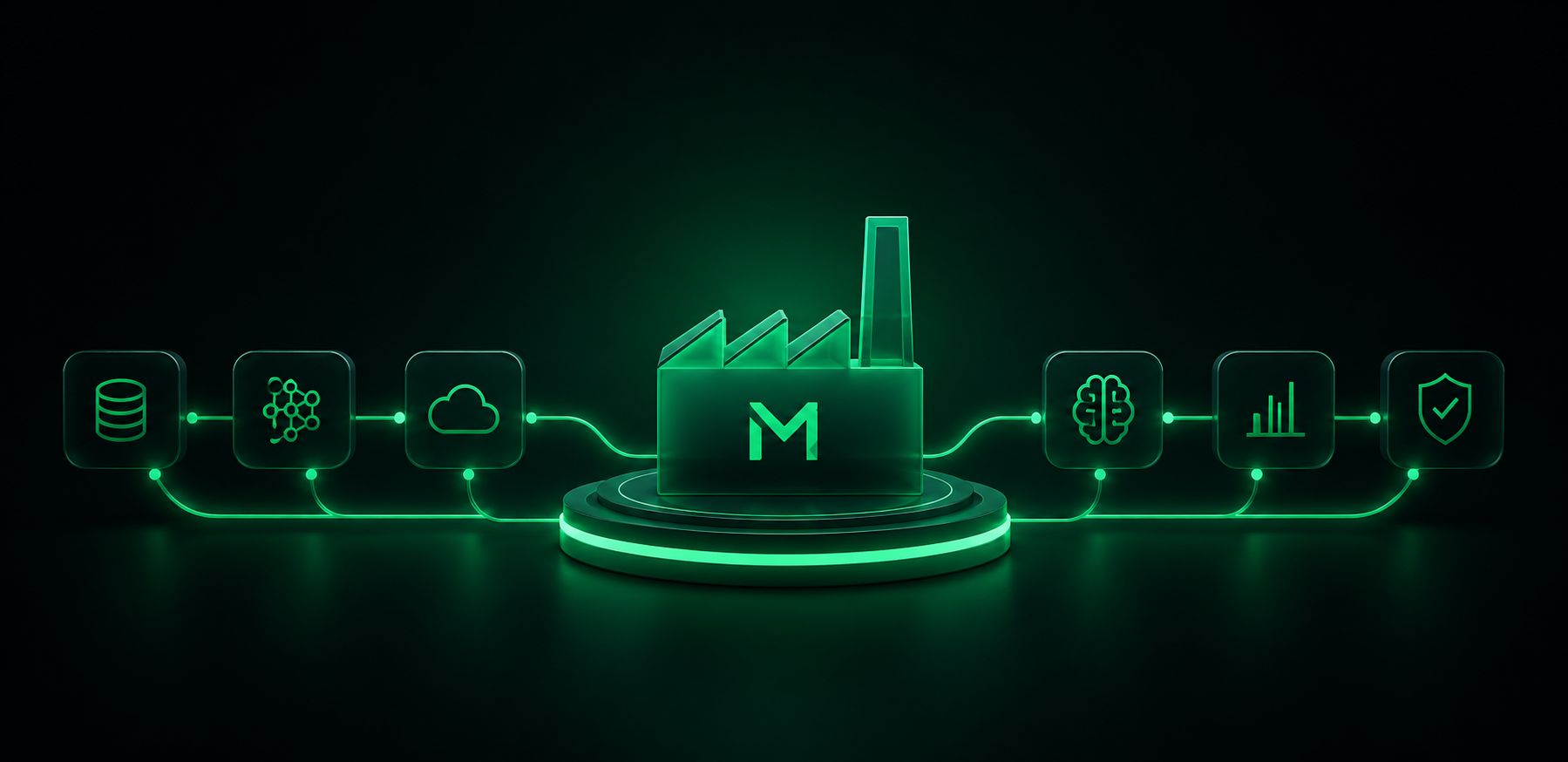

Miami Mike gets a version of this question every week now, usually from a CIO who just watched a cloud invoice climb for the fourth quarter in a row: should we stop renting and build our own enterprise AI factory? Two years ago that was a keynote phrase. Today it is a line item, and every major infrastructure vendor has a product with that name stamped on it.
I sell this category, so weigh my enthusiasm accordingly. The honest version is that owning your inference is a very good idea for a narrow band of workloads and an expensive mistake for everything else. What follows is what the major platforms actually are, what the numbers look like when you strip the marketing off, and the specific conditions under which the math works.
What an enterprise AI factory actually is
Strip the branding and it is a pre integrated stack you buy as one thing: GPUs, networking, storage, orchestration software, a model catalog, and a services wrapper to stand it up. NVIDIA coined the term and its framing is the useful part. A traditional data center stores files. An AI factory produces tokens, and the unit of output is what you measure it by. NVIDIA’s own people have been blunt that infrastructure only earns the name once an organization is generating tokens from its own data, which rules out most of what gets called an AI factory in press releases.
That reframing matters more than it sounds, because it changes the metric. Not GPU count. Not teraflops. Tokens per watt. NVIDIA claims its GB300 NVL72 systems produce 50 times more tokens per megawatt than the Hopper generation, at 35 times lower cost per token. Treat vendor efficiency multipliers as directional. But the direction is correct, and power is roughly 40 percent of what it costs to run one of these things, so efficiency per watt is not a sustainability talking point. It is the P&L.
Underneath every OEM product sits the same substrate: the NVIDIA Enterprise AI Factory validated design, built on Blackwell compute, BlueField DPUs, Spectrum-X Ethernet, and NVIDIA AI Enterprise software. The OEMs differentiate on integration, services, financing, and how much of the operational burden they take off your team. Knowing that keeps you from overpaying for a difference that does not exist.
Dell AI Factory with NVIDIA has the widest portfolio
Dell was first to market with the name and has the broadest span, from a workstation under a desk to liquid cooled rack scale systems. As of Dell Technologies World in May 2026, more than 5,000 customers were deploying it, up a thousand in a single quarter. That is the largest installed base in the category and it is the main reason Dell shows up on most shortlists by default.
The interesting piece this year was not the big iron. It was Deskside Agentic AI, which puts agent workloads on a workstation next to the person running them, on the theory that a coding agent chewing through context all day does not need a data center and definitely does not need a metered API. Dell claims break even against public cloud API costs for agentic workloads of various sizes, backed by a Signal65 and Futurum analysis it commissioned.
On the ROI figures, read the footnotes. Dell cites early adopters seeing up to 2.6 times return in the first year. The deeper Enterprise Strategy Group economic analysis behind a lot of the Dell numbers was modeled on Llama 3 70B for inference and fine tuning over a four year period on XE9680 servers with H100 GPUs. That is a legitimate model. It is also a specific workload on hardware that is now two generations old, commissioned by the vendor. Useful as a shape, not as your forecast.
HPE Private Cloud AI sells the turnkey end of the market
HPE Private Cloud AI, or PCAI, takes the opposite posture. Where Dell sells you range, HPE sells you a finished thing. It arrives as a co engineered stack delivered through GreenLake, with a single console for deploying, monitoring, and governing workloads, a unified data lakehouse, NVIDIA NIM microservices, and validated blueprints so you skip months of integration work.
The 2026 updates pushed it up market. At Discover in June, HPE said it had scaled Private Cloud AI inference clusters to 256 Blackwell class GPUs and added NVIDIA Agent Toolkit and Confidential Computing, with the Vera CPU based ProLiant DL394 arriving in 2027. Earlier in the year it added air gapped deployment for environments that cannot touch a network, which is the configuration that actually matters in defense, healthcare, and parts of financial services.
My read: if you have platform engineers who want control, PCAI will feel constraining. If you do not have them, it is the fastest credible path to production and the console alone justifies a chunk of the premium. Just go in knowing that GreenLake consumption pricing means you may not be converting opex to capex at all, which I will come back to.
Lenovo, Cisco, Supermicro and the rest of the field
Lenovo has been the most aggressive on economics. Its Hybrid AI Advantage platforms claim ROI in under six months and up to 8 times lower cost per token than comparable cloud IaaS, with breakeven under four months for high utilization workloads. Lenovo also commissioned the IDC CIO Playbook 2026 finding that 84 percent of organizations expect to run AI on premises or at the edge alongside cloud, which is the stat every vendor in this category now quotes back at you.
Cisco brings the network and security angle and partners with Lenovo on validated designs. Supermicro competes on density and price. Red Hat launched an AI Factory software layer with NVIDIA that runs across Cisco, Dell, Lenovo, and Supermicro hardware, which tells you where this is heading: the software stack commoditizes across vendors, and the hardware differentiation narrows to cooling, density, and who answers the phone at 2am.
| Platform | What you are buying | Best fit | The number they lead with |
|---|---|---|---|
| Dell AI Factory with NVIDIA | Broadest range, workstation through rack scale, plus data platform | Enterprises that want one vendor across every tier | 5,000 plus customers, up to 2.6x first year ROI |
| HPE Private Cloud AI | Turnkey stack, single console, delivered via GreenLake | Teams without dedicated platform engineers, regulated and air gapped environments | Inference clusters to 256 Blackwell class GPUs |
| Lenovo Hybrid AI Advantage | Validated hybrid designs from edge to gigawatt scale cloud | Cost per token driven buyers with steady inference | 8x lower cost per token vs cloud IaaS |
| NVIDIA Enterprise AI Factory | The validated reference design every OEM builds against | Anyone who wants to know what is actually under the badge | 50x tokens per megawatt, GB300 vs Hopper |
Cost per token is the number that decides it
Everything above is a way of buying a lower cost per token. That is the entire pitch. Which means the evaluation is not really about vendors, it is about whether your workload profile can hit the utilization these models assume. I wrote a whole piece on why AI inference costs keep climbing even as token prices collapse, and the short version is that agents compound usage in ways no per seat budget anticipated. An AI factory is one answer to that. It is not the first one you should try.
Before you buy anything, get routing right. Sending every request to your most capable model because that is how the proof of concept was built is the single most expensive habit in enterprise AI, and fixing it is free. A real multi model AI strategy will cut more cost in a quarter than a hardware purchase will in a year, and it also tells you which workloads are steady enough to justify owning. You cannot size a factory for demand you have never measured.
Deloitte’s 2026 threshold is the cleanest trigger I have seen: when monthly cloud AI spend reaches 60 to 70 percent of what equivalent owned hardware would cost amortized over the same period, start the evaluation. Below that, keep renting.
How an AI factory turns opex into capex, and where that breaks
The argument CFOs actually respond to goes like this. Cloud inference is pure operating expense that scales with usage forever and produces no asset. Owned infrastructure is a capital purchase you depreciate over three to five years, and once it is amortized your marginal cost collapses to power, cooling, and the people who run it. Same workload, different balance sheet treatment, and the second one is a lot easier to defend when the board asks what you got for the money.
Three things break that story if you are not careful.
- Consumption financing. GreenLake and APEX style models are excellent for cash flow and terrible for the capex narrative, because you are still paying monthly. Decide which outcome you actually want before you pick a delivery model.
- Software licensing never amortizes. NVIDIA AI Enterprise is a recurring line on top of hardware, reported at roughly $4,500 per GPU per year based on Dell’s published five year pricing. On a few hundred GPUs that is real money that behaves exactly like the opex you were trying to escape.
- The asset depreciates faster than the schedule. Vera Rubin NVL72 systems land in December 2026 and Rubin Ultra follows in 2027. Your five year depreciation is running against an eighteen month product cadence, so model residual value honestly or not at all.
None of that kills the argument. It just means the capex case rests on sustained utilization, not on accounting treatment. If the boxes sit idle, you converted a variable cost into a fixed one and made your problem worse.
When an enterprise AI factory is the wrong call
This is the section the vendors do not write. Independent analysis puts most production inference teams at 40 to 65 percent GPU utilization because of traffic variability and batching limits, well under the 80 to 90 percent that makes the breakeven charts work. Meanwhile an H100 class server pulls around 10 kW, roughly $10,500 a year in electricity at average US commercial rates, cooling adds another 25 to 40 percent on top of that, idle GPUs still draw about 14 percent of peak, and you need at least half an engineer whose entire job is keeping it healthy.
Signals you are not ready to buy: your token volume swings more than 3x week to week, you cannot say what percentage of spend goes to which workload, your heaviest use case is a frontier reasoning model no open weight alternative matches, or your AI program is under a year old. Any one of those and you should be optimizing what you have. Renting looks expensive until you own something running at 30 percent.
How to size your first AI factory without guessing
Start by measuring monthly token volume broken out by workload and by model, not in aggregate. Then split the list into steady and bursty. Steady, high volume, latency sensitive, or data resident work is what you size the hardware for. Everything else stays on APIs, permanently, and that is fine.
Then test small before you sign anything. Running a quantized open weight model on a single node teaches you more about your real quality bar and throughput needs than any vendor workshop will. My DGX Spark home lab writeup covers the cheapest version of that experiment, and the lessons scale up more cleanly than people expect. When you do go to procurement, price the whole thing: hardware, networking, storage, software licensing, power, cooling, colocation if you need it, and staffing. Vendors quote the first three.
What I am watching next is whether the power software matters as much as NVIDIA says. Its MaxLPS work claims to recover enough stranded rack power to fit up to 40 percent more GPUs in the same facility envelope, which for anyone in a South Florida colo with a hard power cap is a bigger deal than the next GPU generation. If that holds up outside vendor benchmarks, the buy decision shifts again, and I will run the numbers here when it does.



[…] full breakdown of what these platforms cost and what the vendors leave out of the quote is in my enterprise AI factory writeup. The compressed version is that on premise AI inference wins on a narrow band of workloads […]
[…] definition of an AI factory, which I leaned on in the enterprise AI factory post, is infrastructure that produces tokens from your own data. The number that decides whether […]